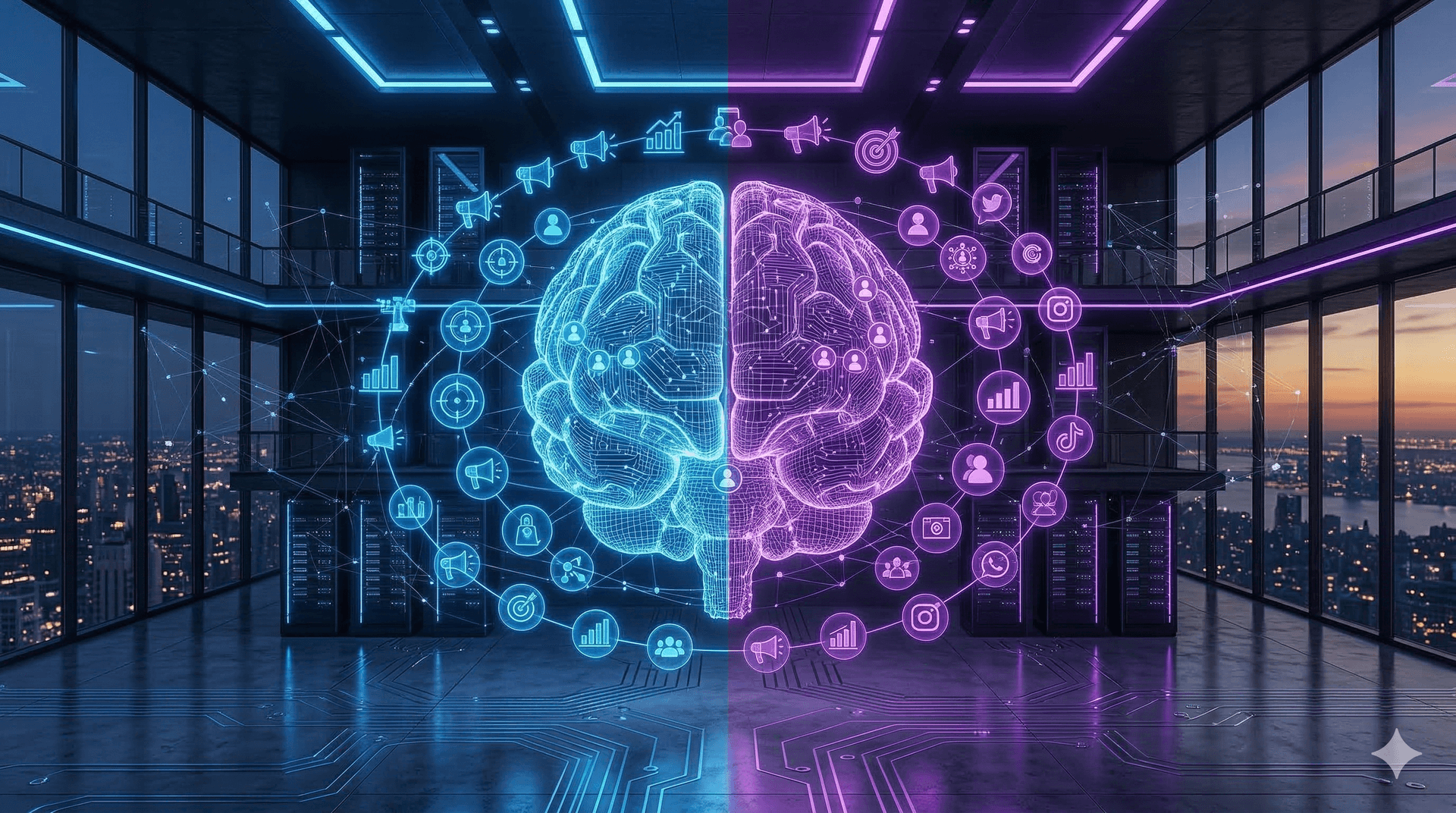
Artificial Intelligence has moved from "future technology" to "table stakes" in modern marketing.
From predictive analytics that forecast campaign outcomes to machine learning models that personalize experiences at scale, AI is fundamentally transforming how marketing works.
Yet many marketing teams still struggle with practical questions:
- How do we actually implement AI?
- Where should we start?
- What's the ROI?
- How do we stay compliant?
- What tools do we use?
This comprehensive guide covers everything you need to know about AI in marketing – theory, applications, tools, and implementation strategies.
Why AI Matters for Marketing Right Now
The Numbers
Companies implementing AI report:
- 25-35% improvement in conversion rates
- 20-30% better budget efficiency
- 2-3x improvement in ROI
- 40-60% faster campaign optimization
- 3-5x improvement in lead quality
Market reality:
- 72% of companies already using AI in marketing
- AI in marketing budgets growing 38% annually
- By 2026, AI will be standard, not optional
- Early adopters have significant competitive advantage
The Competitive Pressure
Companies NOT using AI report:
- Slower decision-making
- Higher customer acquisition costs
- Lower conversion rates
- Difficulty scaling campaigns
- Loss of talent (people want to work with modern tech)
The gap is widening: Early adopters are pulling ahead significantly.
What AI Can Do for Marketing
1. Predict Campaign Outcomes
Traditional approach:
- Launch campaign
- Wait for results
- Hope it performs
AI approach:
- Analyze past data
- Predict outcomes before launch (85-92% accuracy)
- Optimize before you spend budget
- Launch only when prediction shows success
Impact: 20-30% better campaign ROI through better targeting
See: Predictive Analytics in Marketing
2. Find Better Customers
Traditional approach:
- Manual audience segmentation
- Static targeting rules
- Everyone in segment gets same message
AI approach:
- Automatically discover audience segments
- Predict who will convert
- Personalize for each individual
- Continuously optimize targeting
Impact: 3-5x improvement in customer acquisition efficiency
See: AI-Driven Audience Analysis
3. Optimize Everything Automatically
What AI optimizes:
- Send times (when to email each person)
- Subject lines (which one resonates)
- Creative (which images/copy work)
- Channels (email vs. SMS vs. social)
- Budget (where to allocate next $)
- Content (what to show each person)
Traditional optimization: Manual A/B testing, weeks to optimize AI optimization: Automated, continuous, real-time adjustments
Impact: 2-5x improvement through optimization
See: Marketing Automation with AI
4. Personalize at Scale
Traditional approach:
- Segment audience into 5-10 groups
- Everyone in group gets same experience
AI approach:
- Personalize for each individual (millions of variations)
- Based on behavior, preferences, predicted next action
- Changes dynamically as they interact
- Increases relevance dramatically
Impact: 30-50% improvement in engagement and conversion
See: AI-Driven Audience Analysis
5. Find High-Value Opportunities
AI discovers:
- Which leads are most likely to convert
- Which customers are at churn risk
- Which products to recommend to each person
- Which markets to expand into
- Which trends are emerging
Impact: Revenue increases through better prioritization
See: Machine Learning in Marketing
6. Scale Content Production
AI helps with:
- Brainstorming (100 ideas in minutes)
- Drafting (first drafts for humans to refine)
- Scaling (1 article → 10 variations)
- Optimization (SEO, format, tone)
- Personalization (different versions for audiences)
Impact: 4-10x productivity improvement with maintained quality
See: AI Content Creation vs. Human
AI Tools by Marketing Function
Content and Creative
Best tools:
- ChatGPT (for brainstorming and drafting)
- Claude (for high-quality, long-form content)
- Jasper (for marketing-specific content)
- Midjourney (for image generation)
- Canva AI (for design at scale)
See: The Best AI Marketing Tools Comparison
Search and SEO
Best tools:
- Surfer SEO (for on-page optimization)
- MarketMuse (for content strategy)
- Clearscope (for semantic optimization)
- SE Ranking (for all-in-one SEO)
New approach:
- Generative Engine Optimization (optimizing for AI search)
See: Generative Engine Optimization
Influencer Marketing
Best tools:
- femosos (predictive influencer analytics)
- HypeAuditor (influencer discovery)
- Modash (creator database)
- CreatorIQ (enterprise management)
See: AI in Influencer Marketing
Analytics and Insights
Best tools:
- Google Analytics 4 (web analytics with AI)
- Mixpanel (behavioral analytics)
- Amplitude (product analytics)
- Looker or Tableau (business intelligence)
Marketing Automation
Best tools:
- HubSpot (all-in-one with AI)
- ActiveCampaign (sophisticated automation)
- Marketo (enterprise automation)
- Brevo (European alternative)
See: Marketing Automation with AI
Implementation Strategy: The 5-Step Roadmap
Phase 1: Assessment and Alignment (2-4 weeks)
Activities:
- Audit current marketing processes
- Identify biggest pain points
- Assess data availability
- Define success metrics
- Align team and leadership
Outcome: Clear understanding of opportunities and constraints
Phase 2: Quick Win (4-8 weeks)
Choose one high-impact, manageable project:
- Lead scoring (identifies best leads)
- Send time optimization (improves email performance)
- Churn prediction (identifies at-risk customers)
- Content optimization (improves SEO)
Goal: Prove ROI, build confidence, gain learnings
Expected result: 20-40% improvement in chosen metric
Phase 3: Tool Selection and Setup (4-8 weeks)
Based on findings from Phase 2:
- Select platforms for your use case
- Implement integrations
- Set up data pipelines
- Configure workflows
Considerations:
- Ease of use
- Integration with existing stack
- Cost vs. capability
- Vendor stability
See: AI Marketing Tools Comparison
Phase 4: Team Training and Adoption (2-4 weeks)
Training required:
- How to use new tools
- Interpreting AI insights
- Ethics and compliance
- Best practices
Adoption strategies:
- Start with early adopters
- Share success stories
- Address concerns
- Celebrate wins
Phase 5: Scale and Optimize (3-6 months+)
Activities:
- Expand to additional use cases
- Integrate multiple AI systems
- Continuously optimize
- Monitor for bias and issues
- Evolve strategy based on learnings
Measuring AI Marketing ROI
Key Metrics to Track
Input Metrics (what you invest):
- Tool costs
- Team time
- Data infrastructure
- Training and development
Output Metrics (what you get):
- Conversion rate improvement
- Cost per acquisition decrease
- Customer lifetime value increase
- Campaign ROI improvement
- Time savings
Business Metrics (actual impact):
- Revenue increase
- Profit improvement
- Market share gain
- Customer retention
- Brand health
ROI Calculation
Simple example:
Before AI:
- 10,000 leads/month at 2% conversion = 200 customers
- Customer acquisition cost: $500
- Customer lifetime value: $2,000
- Monthly revenue: 200 × $2,000 = $400,000
- Monthly cost: 10,000 × $500 = $5,000,000
After AI (lead scoring + personalization):
- 10,000 leads/month at 3% conversion = 300 customers
- Customer acquisition cost: $350 (better targeting)
- Customer lifetime value: $2,200 (better fit)
- Monthly revenue: 300 × $2,200 = $660,000
- Monthly cost: 10,000 × $350 = $3,500,000
Monthly improvement:
- Revenue increase: +$260,000
- Cost decrease: -$1,500,000
- Profit improvement: +$1,760,000
AI tool cost: $10,000/month
Net monthly benefit: $1,750,000
ROI: 175x
Avoiding Common AI Marketing Mistakes
❌ Mistake 1: Implementing Without Clear Goal
Why it fails: AI is a solution looking for problem Prevention: Start with business goal, work backward to AI
❌ Mistake 2: Neglecting Data Quality
Why it fails: Garbage in, garbage out Prevention: Invest 30-40% of time in data quality before modeling
❌ Mistake 3: Ignoring Bias and Ethics
Why it fails: Discriminatory AI causes legal and brand damage Prevention: Audit for bias, ensure compliance with GDPR/CCPA
❌ Mistake 4: Deploying Without Testing
Why it fails: Real-world performance differs from models Prevention: A/B test before full rollout
❌ Mistake 5: Fire and Forget
Why it fails: Model accuracy degrades over time Prevention: Continuous monitoring and retraining
The Future of AI in Marketing
Near-Term (2026-2027)
- Real-time optimization: Campaigns adjusting minute-by-minute
- Better personalization: Moving from segment to individual
- AI search dominance: Generative AI search becoming mainstream
- Privacy-preserving AI: New technologies protecting privacy while optimizing
- AutoML becoming standard: Easier for non-technical teams to use
Medium-Term (2027-2029)
- Autonomous campaigns: Fully automated marketing systems
- Multimodal AI: AI understanding text, images, video together
- Causal AI: Understanding not just correlation but causation
- Federated learning: Training on distributed data without centralization
- Vertical specialization: AI models trained specifically for industries
Long-Term (2030+)
- Adaptive strategies: AI that evolves strategy in real-time
- Predictive product development: Using customer insights to drive innovation
- Full marketing automation: Humans provide strategy, AI handles execution
- Proactive marketing: Predicting needs before customers know them
- Ethical AI standards: Regulation requiring responsible AI
Learning Resources
In-Depth Guides
- Predictive Analytics in Marketing – Detailed guide to forecasting
- Machine Learning in Marketing – ML algorithms explained
- Data-Driven Marketing – Building data culture
- AI-Driven Audience Analysis – Understanding customers with AI
- Marketing Automation with AI – Intelligent workflows
Use Case Guides
- AI in Influencer Marketing – Predictive creator selection
- Generative Engine Optimization – Optimizing for AI search
- AI Content Creation vs. Human – Hybrid content strategy
Tools and Implementation
- The Best AI Marketing Tools Comparison – Comparing platforms
- AI Ethics in Marketing – Compliance and ethics
Your Next Steps
For Marketers New to AI
- Learn the basics: Read this guide completely
- Explore tools: Try ChatGPT or Claude for brainstorming
- Take a course: Udemy or Coursera has affordable AI basics
- Join community: Subscribe to AI in marketing newsletters
- Experiment: Pick one tool, use it for 2 weeks
For Marketing Leaders
- Audit capabilities: What AI are you already using?
- Identify opportunities: Where would AI have biggest impact?
- Allocate budget: Dedicate resources to AI implementation
- Build team: Hire or train for AI competencies
- Set strategy: Define 3-year AI roadmap
For Marketing Teams
- Run a pilot: Pick highest-impact use case
- Measure baseline: Establish current performance metrics
- Implement carefully: Test before full rollout
- Monitor results: Track improvement
- Share learnings: Document what you learn
Final Thoughts
AI in marketing isn't optional anymore. It's the difference between companies that scale and those that plateau.
The good news: You don't need to be a data scientist to leverage AI. Modern tools are increasingly accessible to marketers.
The challenge: Choosing where to start, implementing thoughtfully, and ensuring ethical use.
The opportunity: Companies that master AI marketing will outcompete those that don't by 2-5x on key metrics.
The time to start is now. Not next year, not after more research – now. Pick your first use case, implement, learn, and iterate.
Your competitors are already moving. The question is: how quickly will you catch up?
Questions?
Still have questions about AI in marketing? These detailed guides cover specific aspects:
- "How accurate are AI predictions?" → Predictive Analytics
- "How do I choose the right tool?" → Tools Comparison
- "Is this legal/ethical?" → AI Ethics and GDPR
- "How do I get started?" → Each implementation guide has "Next Steps"
- "What about influencer marketing?" → AI in Influencer Marketing
About femosos: femosos applies AI to influencer marketing, predicting creator performance and optimizing campaigns. Our platform helps brands use artificial intelligence to find better creators, forecast results, and maximize influencer marketing ROI.