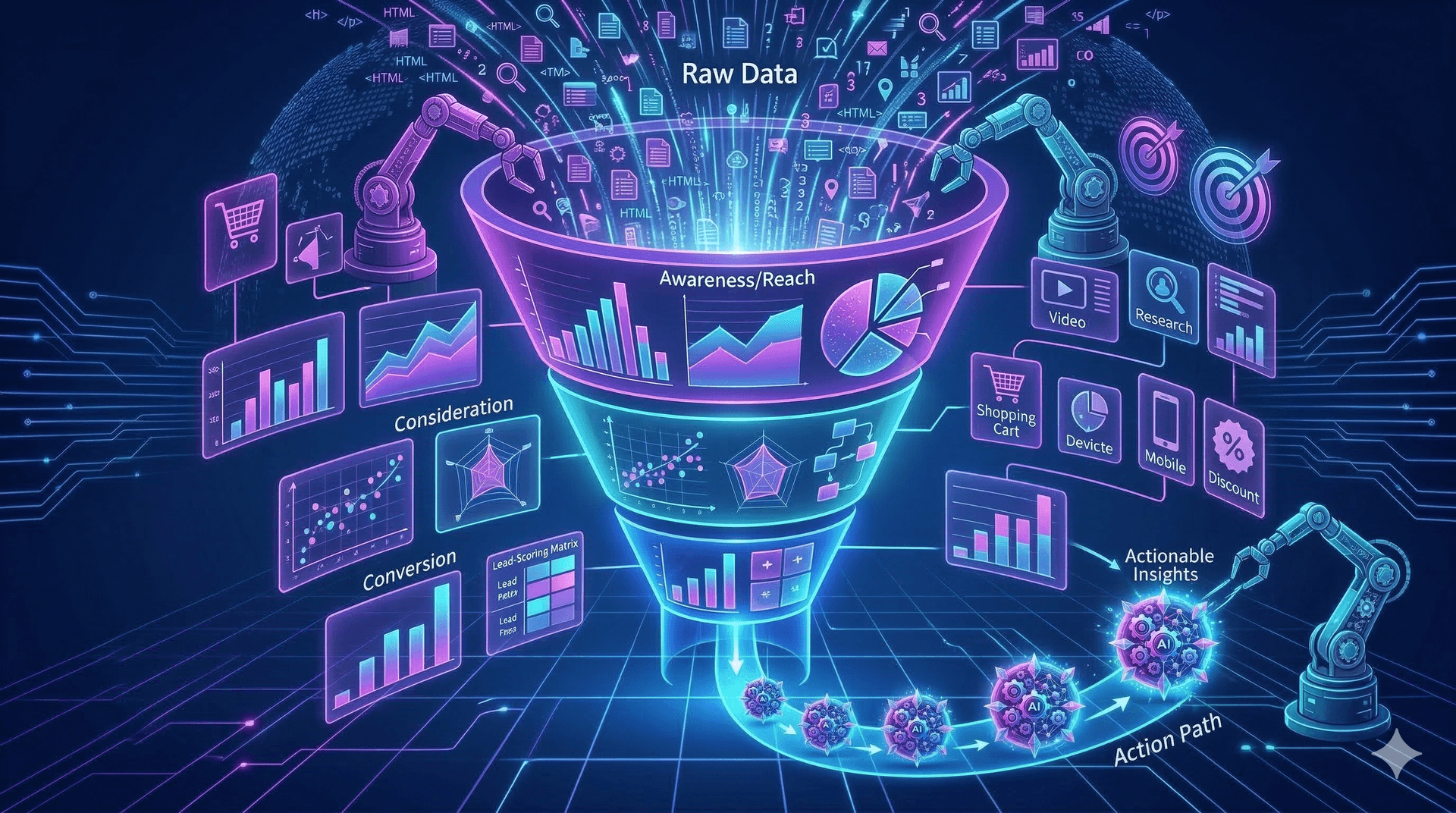
Great marketing has always been about understanding what works. For decades, this meant experience, intuition, and A/B testing.
Today, data is everywhere. The question is no longer "Do we have data?" but "Are we actually using it?"
Data-driven marketing means making decisions based on evidence, not opinions. It means measuring what matters, understanding what drives results, and continuously optimizing based on what you learn.
This guide explores how to build a truly data-driven marketing organization.
The Cost of Non-Data-Driven Marketing
The Problem
According to research:
- 60% of marketing decisions are still based on intuition
- Only 30% of marketers say they have good data quality
- 50% of marketing teams can't explain why campaigns succeeded or failed
- Average marketing waste: $20-30k per company annually
Real-World Examples
Company A (Non-data-driven):
- Launches email campaign based on what "feels right"
- Gets 2% open rate
- Blames the product, tries new subject line
- Still gets 2%, doesn't understand why
- Abandons email as ineffective
- Loses millions in potential revenue
Company B (Data-driven):
- Analyzes past email performance data
- Discovers optimal send times, subject lines, content
- A/B tests with confidence
- Gets 5%+ open rate
- Continues optimizing based on data
- Scales email program with predictability
The Difference
One company is flying blind. The other is operating with a dashboard and instruments.
The Four Pillars of Data-Driven Marketing
Pillar 1: Strategic Data Collection
Before you can analyze, you must collect the right data.
Types of Data to Collect:
1. Behavioral Data
- Website visits (what pages people visit)
- Content engagement (what they read, watch, listen to)
- Purchase behavior (what they buy, when, how much)
- Product usage (features used, frequency, time spent)
- Click patterns (email links, ads, CTAs)
- Video/content consumption (watch time, completion)
2. Customer Data
- Demographics (age, gender, location, income)
- Firmographics (company size, industry, revenue)
- Lifecycle stage (lead, customer, retained, churned)
- Engagement history (interactions, touchpoints)
- Support interactions (issues, resolution time)
- Sentiment (satisfaction scores, reviews)
3. Campaign Data
- Impressions and reach
- Engagement metrics (clicks, opens, shares)
- Conversion metrics (leads generated, sales)
- Cost data (spend, CPC, CAC)
- Time data (campaign duration, seasonal patterns)
- Channel performance (email vs. social vs. ads)
4. External Data
- Market trends and industry data
- Competitive activity
- Economic indicators
- Seasonal patterns
- Search trends
- Social media trends
Implementation:
- Use analytics tools (Google Analytics, Mixpanel, Amplitude)
- Implement CRM properly (Salesforce, HubSpot)
- Connect all platforms (API integrations)
- Create unified data warehouse (DataWarehouse, Snowflake)
- Ensure data quality and standardization
Pillar 2: Rigorous Analysis
Data only matters if you analyze it correctly.
Types of Analysis:
1. Descriptive Analytics
- What happened?
- "Our last campaign generated 50,000 impressions and 2.5% CTR"
- Looking backward at what happened
- Foundation for other analyses
2. Diagnostic Analytics
- Why did it happen?
- "Why was CTR 2.5%? Because send time was optimal and subject line was compelling"
- Understanding causes of outcomes
- More complex analysis
3. Predictive Analytics
- What will happen?
- "Next campaign will likely achieve 3.2% CTR based on these factors"
- Forecasting based on patterns
- High business value
4. Prescriptive Analytics
- What should we do?
- "To improve CTR to 4%, you should adjust send time and A/B test subject lines"
- Recommending actions
- Highest business value
Analysis Discipline:
✓ Ask clear questions before analyzing ✓ Use statistical methods properly ✓ Control for confounding variables ✓ Check for correlation vs. causation ✓ Validate findings on new data ✓ Consider alternative explanations
Common Analysis Mistakes:
❌ Correlation = Causation
- "Customers who received email also clicked link" ≠ "Email caused click"
- Control group required to prove causation
❌ Survivorship Bias
- Only analyzing successful campaigns, ignoring failures
- Gives false picture of what works
❌ P-Hacking
- Testing 100 variations until one shows "significance"
- Results won't replicate
- Need rigorous testing methodology
❌ Ignoring Regression to Mean
- "Campaign outperformed, let's do exactly the same" – ignores luck
- Need sufficient sample size and multiple tests
Pillar 3: Actionable Insights
Great analysis is only valuable if it leads to action.
From Data to Insight to Action:
Example 1:
Data: Last 12 months of email performance shows 9 AM send time
has 35% higher open rate than 6 PM
Analysis: Send time significantly impacts open rates
Optimal time is 9 AM for this audience
Insight: We can improve email performance by 35% by changing send times
Action: Implement automated 9 AM sends for all future campaigns
Measure impact on open rates
Continue A/B testing other send times
Example 2:
Data: Customers who watch 3+ product demo videos have 5x higher
conversion rate than those who watch 0-2
Analysis: Video engagement correlates with conversion
Insight: Demo videos are key to conversion for this audience
Action: Increase visibility of demo video
Place earlier in customer journey
Create more demo videos for different use cases
Track video consumption as leading indicator
What Makes an Insight Actionable?
✓ Specific (not "people like videos" – "customers who watch demos convert 5x higher") ✓ Quantified (attach numbers) ✓ Directional (clear action emerges) ✓ Validated (confirmed across multiple data points) ✓ Timely (relevant to current situation)
Pillar 4: Continuous Optimization
Data-driven marketing is not one-time analysis – it's continuous improvement.
The Optimization Cycle:
- Measure current state (baseline metrics)
- Analyze to understand what's working
- Hypothesize what could improve
- Test the hypothesis (A/B test)
- Measure results
- Learn what worked
- Scale what works
- Repeat with new hypotheses
Optimization Discipline:
- A/B Testing: Test one variable at a time
- Sample Size: Ensure enough data for significance
- Duration: Run tests long enough to account for variability
- One Metric: Focus on one primary metric per test
- Statistical Significance: Use 95% confidence level minimum
- Rollout: Only scale winners; iterate on losers
Examples:
✓ Good test:
- Test: Subject line variation (keep everything else identical)
- Duration: 2 weeks (accounting for weekly patterns)
- Sample: 10,000 recipients (large enough for significance)
- Metric: Open rate
- Result: Version A wins, implement for all future sends
✗ Bad test:
- Changed: Subject line AND send time AND content (3 variables)
- Duration: 3 days (too short)
- Sample: 100 recipients (too small)
- Metric: Click rate AND conversion AND satisfaction (too many metrics)
- Result: Unclear what actually caused improvement
Building a Data-Driven Culture
Strategy 1: Make Data Accessible
Problem: Data exists in silos; teams can't access what they need
Solution:
- Create dashboards showing key metrics
- Provide self-service analytics tools
- Train teams on how to find and interpret data
- Create data dictionary (what metrics mean)
- Establish single source of truth
Tools: Looker, Tableau, Google Data Studio, Metabase
Strategy 2: Align on Metrics
Problem: Everyone measures different things; confusion about performance
Solution:
- Define company-level goals (revenue, growth, retention)
- Define marketing-level goals (leads, conversions, CAC)
- Define campaign-level KPIs
- Create aligned dashboard showing all levels
- Monthly review of metrics
Example Hierarchy:
Company Goal: Grow revenue 50% YoY
Marketing Goal: Generate 10,000 qualified leads
Campaign Goals:
- Email: 5,000 leads
- Paid ads: 3,000 leads
- Organic: 2,000 leads
Metrics to Track:
- Email: sends, open rate, click rate, leads generated
- Ads: impressions, CTR, CAC, conversion rate
- Organic: traffic, engagement, leads
Strategy 3: Invest in Quality Data
Problem: Poor data quality makes all analysis questionable
Solution:
- Standardize data collection (consistent format, naming)
- Clean data regularly (remove duplicates, fix errors)
- Document data lineage (where does it come from?)
- Establish data governance (who can access what)
- Audit data quality regularly
Cost: 30-40% of data projects, but worth it Payoff: All subsequent analysis is reliable
Strategy 4: Build Analytics Literacy
Problem: Teams don't understand what data means
Solution:
- Train on basic statistics (correlation, causation, significance)
- Teach common mistakes (survivorship bias, p-hacking)
- Explain analytics tools and how to use them
- Create documentation and templates
- Share learnings across team
Result: Better decision-making, fewer mistakes
Strategy 5: Fail Fast, Learn Quick
Problem: Teams avoid testing because they fear failure
Solution:
- Normalize testing and failure
- Celebrate what you learn from failures
- Create safe environment for experimentation
- Document all tests and results
- Share learnings widely
Mindset: "This test failed, so we learned what NOT to do next time"
Data-Driven Marketing in Practice
Example 1: Email Marketing Optimization
Starting Point:
- 2% open rate, 0.5% click rate
- No A/B testing discipline
- Sent same time every day
Data-Driven Approach:
- Measure: Baseline = 2% open, 0.5% click
- Analyze: Which emails perform well? What's different?
- Discover:Emails sent at 9 AM have 4% open ratePersonalized subject lines have 3.5% vs 1.5% genericVideos perform better than images (3% vs 1.5% click rate)
- Test:Send time: 9 AM vs 12 PM (9 AM wins)Subject lines: Personalized vs generic (personalized wins)Content: Video + images vs images only (wins)
- Implement: Apply winning variations to all campaigns
- Measure: New baseline = 5.2% open, 2.1% click (2.6x improvement)
- Iterate: Test new variations on top of winners
Result: Email ROI improves 2.5-3x through continuous optimization
Example 2: Campaign Attribution
Problem: "I don't know which channel drives conversions"
Data-Driven Approach:
- Implement tracking: UTM parameters on all channels
- Connect data: Tie touches to conversions
- Model attribution:First-touch (credit first channel): Email gets creditLast-touch (credit last channel): Organic gets creditMulti-touch (credit all channels): Linear, time-decay, or custom
- Analyze:Which channels drive first touch? (awareness)Which channels close deals? (conversion)Which channels enable conversion? (assist)
- Optimize budget:Spend on channels that create awarenessOptimize channels that close dealsSupport channels that assist
Result: Budget allocated based on actual contribution to revenue
Example 3: Predictive Personalization
Problem: Treating all leads the same; poor conversion rates
Data-Driven Approach:
- Collect data: Build customer profiles (50+ attributes per person)
- Analyze history: Which types convert? Which types churn?
- Build model: Predict conversion probability for each lead
- Segment: Create segments based on predicted behavior
- Personalize:High conversion-probability leads: Aggressive nurturingMedium: Standard nurturingLow: Light nurturing, focus on education
- Measure: Sales focuses on high-probability leads, improves close rate
Result: Conversion rate improves 40-60%
Tools for Data-Driven Marketing
Data Collection & Integration
- Google Analytics 4 (web analytics)
- Mixpanel (behavioral analytics)
- Segment (customer data platform)
- Zapier (workflow automation and integration)
Analysis & BI
- Looker (business intelligence)
- Tableau (data visualization)
- Google Data Studio (free BI)
- Excel/Python (advanced analysis)
Marketing-Specific Analytics
- HubSpot (CRM with analytics)
- Marketo (marketing automation analytics)
- Mixpanel (product and marketing analytics)
- femosos (influencer marketing analytics)
Common Data-Driven Marketing Pitfalls
❌ Pitfall 1: Drowning in Data
Problem: So much data, can't figure out what matters Solution: Focus on top 5-10 key metrics; ignore the rest
❌ Pitfall 2: Analysis Paralysis
Problem: Spend 6 months analyzing, never implement Solution: 80/20 rule – 20% more data collection, move to action
❌ Pitfall 3: No Action from Insights
Problem: Great analysis that doesn't lead to change Solution: Always end analysis with "Therefore, we will..."
❌ Pitfall 4: Correlation = Causation
Problem: Implement changes based on correlated metrics Solution: Require controlled tests to prove causation
❌ Pitfall 5: Vanity Metrics
Problem: Optimizing metrics that don't drive business value Solution: Focus on revenue-impacting metrics
Conclusion: Data-Driven Marketing Wins
The shift to data-driven marketing isn't optional anymore – it's competitive necessity.
Key Takeaways:
✓ Collect strategically: Right data, not all data ✓ Analyze rigorously: Use proper statistical methods ✓ Act decisively: Insights only matter if you implement them ✓ Optimize continuously: Test, learn, implement, repeat ✓ Build culture: Make data accessibility and literacy normal
Companies that master data-driven marketing outperform competitors by 3-5x on key metrics (ROI, conversion rate, customer satisfaction).
Next Steps
- Define key metrics: What 5-10 metrics matter most?
- Audit data quality: Is your data reliable?
- Build dashboards: Make metrics visible to teams
- Start A/B testing: Pick one thing to test this month
- Train teams: Ensure everyone understands the metrics
- Measure and adjust: Review results monthly
Further Reading
- Predictive Analytics in Marketing
- AI in Marketing: The Complete Guide
- Marketing Automation with AI
- Measuring Influencer Marketing ROI
About femosos: femosos helps marketing teams become data-driven in influencer marketing. Our platform provides the analytics and insights needed to optimize creator campaigns based on actual performance data.