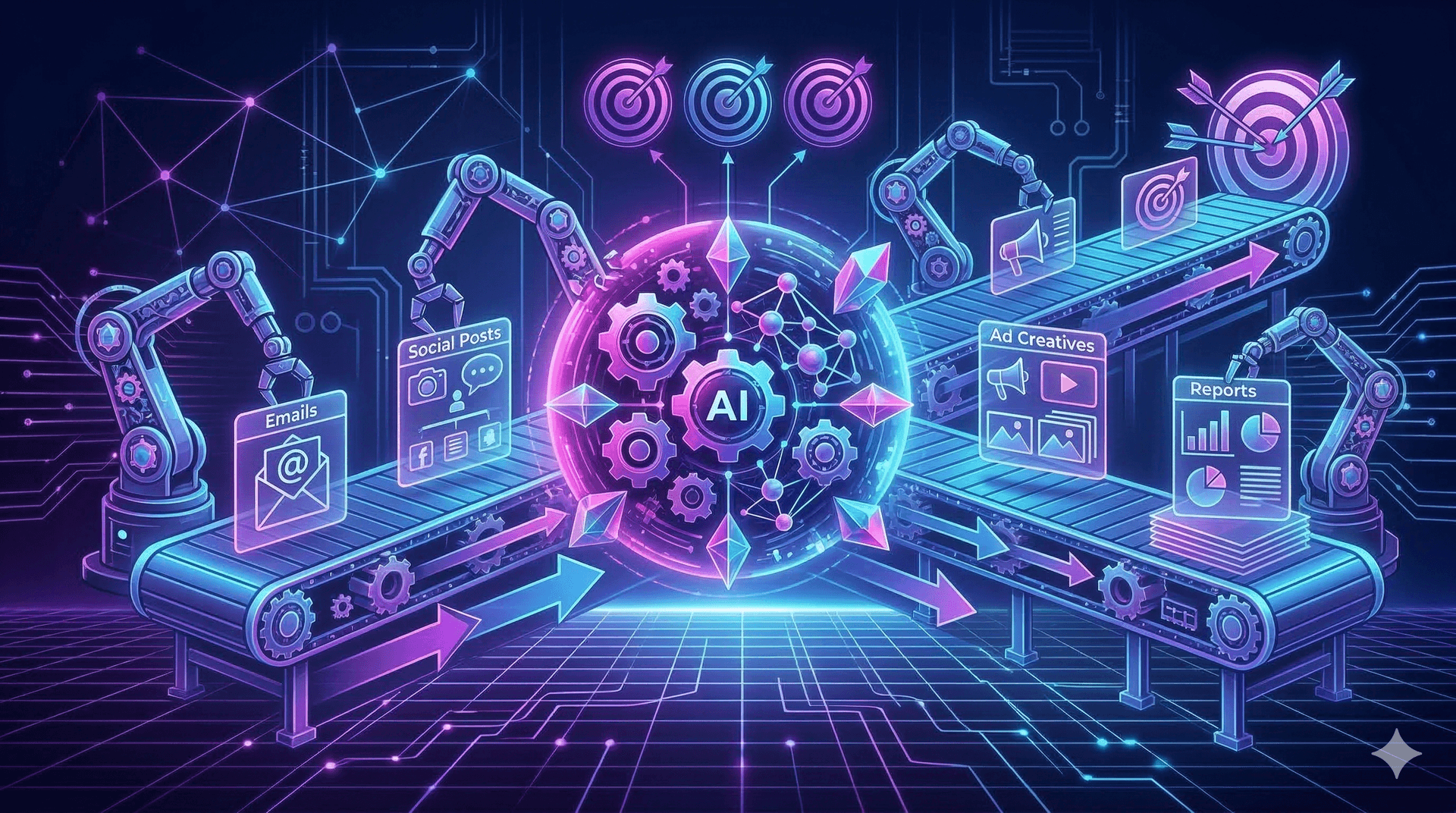
Marketing automation revolutionized how teams scale campaigns. But traditional automation is limited: fixed rules, rigid workflows, reactive optimization.
Then AI arrived, transforming automation from mechanical (if A, then B) to intelligent (understand context, predict outcomes, adapt dynamically).
AI-powered marketing automation means:
- Campaigns that learn and adapt in real-time
- Lead scoring that predicts conversion probability
- Content that personalizes based on individual behavior
- Timing that optimizes for each person's peak engagement window
- Budget allocation that maximizes ROI across channels
This guide explores how to leverage AI to build marketing automation that scales intelligently.
The Evolution of Marketing Automation
Stage 1: Mechanical Rules (2010-2018)
How it worked:
IF email_opened = true THEN send_followup_email
IF click_cta = true THEN move_to_sales_track
IF days_since_signup > 30 THEN send_reactivation
Limitations:
- Binary logic (yes/no decisions)
- No understanding of context
- One-size-fits-all workflows
- Manual rule creation
- Difficult to scale beyond ~20 rules
Stage 2: Data-Driven Automation (2018-2022)
How it worked:
- Segment audiences by demographics and behavior
- Create targeted workflows for each segment
- Use basic analytics to optimize
Improvements:
- More personalization
- Better segmentation
- Data-informed decisions
Limitations:
- Still rules-based (manual definition)
- Limited to historical patterns
- Requires constant manual optimization
- Cannot predict future behavior well
Stage 3: Intelligent AI Automation (2022+)
How it works:
- Machine learning discovers patterns automatically
- Predictive models forecast behavior
- Dynamic optimization adjusts in real-time
- Learns from outcomes and improves continuously
- Context-aware decision-making
Advantages:
- Discovers non-obvious patterns
- Predicts future behavior
- Optimizes continuously
- Personalizes at scale
- Learns and improves automatically
Core AI Automation Capabilities
1. Predictive Lead Scoring
Traditional Lead Scoring:
- Manual point assignment (if company size > 1000 = 10 points)
- Often inaccurate
- Biased toward company size, not conversion probability
AI Lead Scoring:
- Machine learning models trained on historical conversions
- Analyzes 100+ data points per lead
- Predicts conversion probability (0-100%)
- Continuously learns from outcomes
- Adapts to changing patterns
Impact:
- Sales focuses on 20% of leads
- That 20% converts at 3-5x the rate
- Time to close decreases 30%
- Win rates increase 40-60%
Example:
Traditional Scoring:
- Lead from Tech company, 500 employees, $2M ARR
- Score: 45/100 (average)
AI Scoring (trained on your data):
- Same lead has 78% conversion probability
- Recommended: Immediate follow-up
- Predicted deal size: $50K
- Likely close timeframe: 3 weeks
2. Dynamic Content Personalization
Traditional Personalization:
- Same email sent to segment (200 people)
- Everyone sees same landing page
- Single call-to-action
- Static experience
AI Personalization:
- Each recipient gets unique email content
- Dynamic website experiences (changes per visitor)
- Multiple CTAs, best option shown to each person
- Evolves based on engagement
- Behavioral triggers adjust messaging
How it works:
- Behavioral AI analyzes browsing patterns, purchase history, engagement
- Predicts which message resonates most
- Tests variations dynamically
- Optimizes conversion per person
- Learns from interactions
Impact:
- Click-through rates increase 30-50%
- Conversion rates improve 25-40%
- Engagement time increases 40-60%
- Unsubscribe rates drop 50%+
Example:
Same campaign, different AI experiences:
User A (Data-driven engineer):
- Receives email focused on analytics and ROI metrics
- Landing page emphasizes technical capabilities
- CTA: "View technical documentation"
User B (C-level executive):
- Receives email focused on business outcomes
- Landing page emphasizes competitive advantage
- CTA: "Schedule executive briefing"
User C (First-time visitor):
- Receives educational content
- Landing page builds foundation knowledge
- CTA: "Start free trial"
3. Optimal Send Time Prediction
Traditional Approach:
- Send all emails at 9 AM Tuesday (one-size-fits-all)
- Some people check email at night
- Others check during lunch
- Poor timing = lower open rates
AI Approach:
- Analyzes each recipient's email open patterns
- Learns their optimal engagement windows
- Sends email when they're most likely to open
- Continuously adapts as patterns change
- Tests and learns from each send
Impact:
- Open rates increase 20-40%
- Click rates improve 15-30%
- Response times accelerate
- Cost per conversion decreases
4. Churn Prediction and Prevention
How it works:
- ML models analyze customer behavior patterns
- Predict which customers are at risk (0-100% churn probability)
- Identify early warning signs:Declining login frequencyReduced feature usageIncrease in support ticketsChanges in engagement patternsBehavioral shifts
Intervention Options:
- Automated re-engagement campaigns
- Personalized retention offers
- Proactive customer success outreach
- Feature recommendations
Impact:
- Predict churn 30-60 days in advance
- Reduce churn by 20-35% through intervention
- Improve customer lifetime value
- Decrease customer acquisition costs
5. Intelligent Campaign Optimization
Traditional Optimization:
- Launch campaign
- Wait for results
- Analyze after it ends
- Apply learnings to next campaign
AI Optimization:
- Campaign runs
- Real-time performance monitoring
- Automatic A/B testing variations
- Dynamic budget reallocation
- In-flight adjustments
What gets optimized:
- Subject lines: AI tests variations, winners get wider distribution
- Sending times: Adjusts based on performance data
- Creative assets: Shows best-performing images/copy to new recipients
- Channel selection: Routes people through best-performing channels
- Budget allocation: Shifts budget to best-performing segments
- Message sequencing: Optimizes email series order
Impact:
- Campaign performance improves 25-40%
- Time to optimization reduces from weeks to hours
- ROI increases 2-3x through continuous testing
Implementation Framework: Building AI Automation
Phase 1: Data Foundation (4-8 weeks)
Activities:
- Audit current data sources and quality
- Integrate CRM, email, web analytics, transaction data
- Clean and standardize data
- Create unified customer profiles
- Document conversion paths and outcomes
Outcome: Unified data warehouse ready for ML models
Phase 2: Platform Selection (2-4 weeks)
Options:
- Native AI in existing platforms (HubSpot AI, Marketo Einstein, ActiveCampaign AI)
- Specialized automation + AI layer (femosos for influencer marketing AI)
- Build custom (Salesforce Einstein, custom ML models)
Evaluation criteria:
- Ease of use (your team can configure it)
- Integration capabilities (connects to your stack)
- Customization (allows your unique workflows)
- Cost vs. complexity trade-off
Phase 3: Quick Win Implementation (6-12 weeks)
Start with one automation:
- Lead scoring OR
- Send time optimization OR
- Churn prediction
Why one thing first?
- Quick ROI proof
- Team learns capabilities
- Foundation for scaling
Expected timeline:
- Weeks 1-2: Data preparation
- Weeks 3-4: Model training
- Weeks 5-8: Testing and validation
- Weeks 9-12: Deployment and optimization
Phase 4: Scale and Expand (3-6 months)
Once first automation works:
- Expand to additional use cases
- Integrate multiple automations
- Optimize workflows based on learnings
- Train team on new capabilities
Phase 5: Continuous Optimization (ongoing)
- Monitor performance metrics
- Retrain models with new data
- Test new strategies
- Expand to new campaigns/channels
AI Automation Strategy: Best Practices
Practice 1: Start with Your Highest-Value Use Case
Don't: Try to automate everything at once Do: Choose the automation with highest revenue impact
Examples:
- If lead quality is your biggest problem → lead scoring
- If email open rates are poor → send time optimization
- If retention is challenging → churn prediction
- If personalization is weak → dynamic content
Practice 2: Quality Data Is Non-Negotiable
AI only works with good data:
- Clean (accurate, complete)
- Connected (integrated across systems)
- Historical (enough past data to train)
- Labeled (clear outcomes to learn from)
Investment: 30-40% of project time goes to data preparation Payoff: 70-80% of model performance improvements come from better data
Practice 3: Balance Automation with Human Judgment
AI's role: Discover patterns, predict outcomes, suggest optimizations Human's role: Set strategy, validate recommendations, manage exceptions
Example:
AI: "Customer X has 82% churn probability. Recommend:
- Send retention offer worth $500
- Assign success manager"
Humans: "Yes, and also reach out to understand why.
This customer is strategic, let's invest in recovery."
Practice 4: Monitor for Bias
ML models can amplify bias:
- If your historical sales team favored certain demographics, the model learns this bias
- Gender, race, age biases can creep in
- Models may discriminate in credit decisions, hiring, etc.
Safeguards:
- Audit model fairness (test across demographic groups)
- Remove sensitive attributes from training
- Monitor predictions for disparate impact
- Include diverse perspectives in model review
Practice 5: Measure Everything
Key metrics to track:
- Lead Scoring: Conversion rate of high-scoring vs. low-scoring leads
- Send Times: Open rate vs. previous approach
- Churn Prediction: Actual churn vs. predicted churn; intervention success rate
- Personalization: Engagement lift (emails, CTAs) vs. control
- Overall: ROI improvement, cost per lead, customer lifetime value
Real-World Examples
Example 1: B2B SaaS Company
Challenge: Sales team overwhelmed with leads, conversion rate 2%
AI Automation Solution:
- Implement predictive lead scoring
- Route high-scoring leads to sales immediately
- Low-scoring leads → nurture automation
Results (after 3 months):
- High-scoring leads convert at 18% (vs. 2% before)
- Sales closes deals 25% faster
- Sales productivity increases 40%
- Marketing ROI improves 3x
Example 2: E-Commerce Brand
Challenge: Email open rates declining, customers unsubscribing
AI Automation Solution:
- Implement optimal send time prediction
- Dynamic content personalization (product recommendations)
- Automated churn prediction for at-risk customers
- Loyalty program automation
Results (after 6 months):
- Email open rates increase 35%
- Click-through rates improve 28%
- Churn reduces 20%
- Customer lifetime value increases 40%
Example 3: Influencer Marketing Campaign
Challenge: Budget spread across 50 creators, many underperform
AI Automation Solution:
- Use femosos predictive analytics for creator selection
- Dynamic budget reallocation based on performance
- Automated optimization of posting times
- Engagement quality scoring for each creator
Results (after campaign):
- ROI improves 3-5x vs. traditional selection
- Budget waste reduces 60%
- Scaling to 200 creators with same team
- Predictability increases (85%+ accuracy)
Common AI Automation Mistakes
❌ Mistake 1: Implementing AI Without Clear Business Metrics
Why it fails: You can't measure success or prove ROI Solution: Define success metrics BEFORE implementation (lead quality, conversion rate, etc.)
❌ Mistake 2: Trusting AI Models Without Validation
Why it fails: Models can be inaccurate on your specific data Solution: Always test and validate before full deployment
❌ Mistake 3: Treating AI as "Set and Forget"
Why it fails: Models degrade over time as real-world conditions change Solution: Continuously monitor and retrain models
❌ Mistake 4: Over-Complicating Workflows
Why it fails: Complex automation is hard to manage and debug Solution: Start simple, add complexity as you learn
❌ Mistake 5: Ignoring the Human Element
Why it fails: AI recommendations that contradict strategy create friction Solution: Design for human + AI collaboration, not replacement
Selecting an AI Automation Platform
Platform Comparison
| Platform | Best For | AI Capabilities | Price |
|---|---|---|---|
| HubSpot | SMBs and growing companies | Lead scoring, predictive content, churn prediction | Free - $3,200+/month |
| Marketo | Enterprise, complex workflows | Einstein lead scoring, dynamic content | $1,200+/month |
| ActiveCampaign | Mid-market, sophistication | Predictive sending, segmentation | $19-449/month |
| Brevo | German companies, GDPR | Automation, basic AI features | €20-500/month |
| femosos | Influencer marketing automation | Predictive creator performance, campaign optimization | Custom pricing |
Conclusion: AI Automation is Becoming Standard
AI-powered marketing automation is no longer "future tech" – it's becoming table stakes.
Key Takeaways:
✓ AI learns patterns humans miss: Predictive models discover non-obvious optimization opportunities ✓ Automation scales intelligently: Campaigns personalize and optimize at scale ✓ ROI is significant: 2-3x improvements are common in properly implemented systems ✓ Implementation is accessible: Start with one use case, not everything ✓ Humans + AI wins: Best results combine machine intelligence with human judgment
Companies automating intelligently with AI will outpace those using manual or purely rule-based automation by 3-5x in efficiency and effectiveness.
Next Steps
- Audit your current processes: Which ones could benefit from AI automation?
- Define success metrics: How will you measure improvement?
- Choose your first use case: Where is the highest impact?
- Evaluate platforms: Which fits your needs and budget?
- Start with a pilot: Implement one automation and measure results
- Learn and scale: Apply learnings to next automations
Further Reading
- Predictive Analytics in Marketing
- AI in Marketing: The Complete Guide
- Marketing Tools Comparison
- Data-Driven Marketing
About femosos: femosos brings intelligent automation to influencer marketing. Our platform combines predictive analytics with automation to help you select better creators, optimize campaigns, and scale influencer marketing efficiently.